In this guide (6 sections)
- Every free CRM caps either your contacts or your seats
- What HubSpot, Zoho and Freshsales give you at $0
- Free plans hold back automation, branding control and reporting
- Staying free too long costs more than the subscription
- Upgrade when a specific limit starts costing you money
- Start free, but know where the ceiling is
A free CRM feels like a gift: a place for all the contacts living in your phone and inbox, at zero cost. Then your list grows, the automation you need sits behind a paywall, and your emails go out with someone else's logo on them. Here's what the big free CRM plans give you, what they hold back, and when paying starts to make sense.
Every free CRM caps either your contacts or your seats
Every free CRM plan limits you somewhere, so find out where before you build on it. Some cap your data, some cap your team, and most cap the features that save you time.
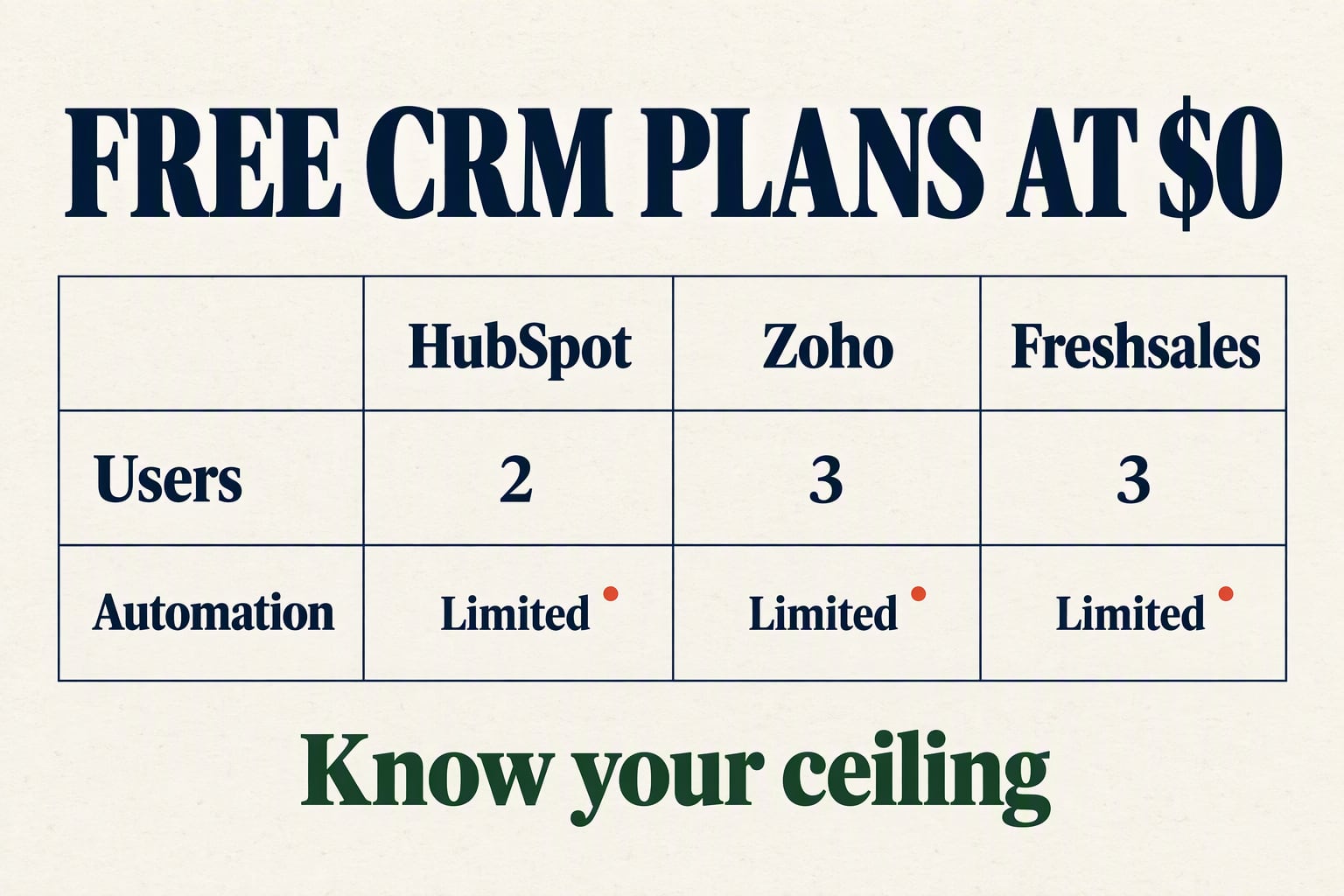
HubSpot caps contacts and seats. Its free plan gives you up to 1,000 marketing contacts and two users, according to HubSpot's pricing page.
Zoho caps users. Its free edition stops at three, per Zoho's pricing page, and Zoho's storage rules put the free edition at about 5,000 records. Freshsales is also free for up to three users, per Freshworks' free CRM page.
So ask which wall you'll hit first. Count your active contacts, then count the people who'll actually log in.
A solo coach with 4,000 leads blows past HubSpot's 1,000 marketing contacts quickly but fits on Zoho or Freshsales. A four-person agency with 200 clients hits the three-user cap on Zoho and Freshsales long before the record count matters.
Pick the free plan that caps the thing you have least of. Switching free CRMs later isn't free: you'll re-map fields, re-import contacts and rebuild every view by hand.
What HubSpot, Zoho and Freshsales give you at $0
All three free plans are enough for a solo consultant with a few hundred contacts. Each is generous in one area and thin in another.
Watch the fine print. HubSpot's 1,000 limit counts marketing contacts, not every record, so you can store more names but can't email past the cap.
All three give you one pipeline. That's fine if you sell one thing. Sell coaching and a course and you'll want two pipelines, which usually means paying.
One upside: all three include mobile apps on the free tier, so you can log a call right after the meeting.
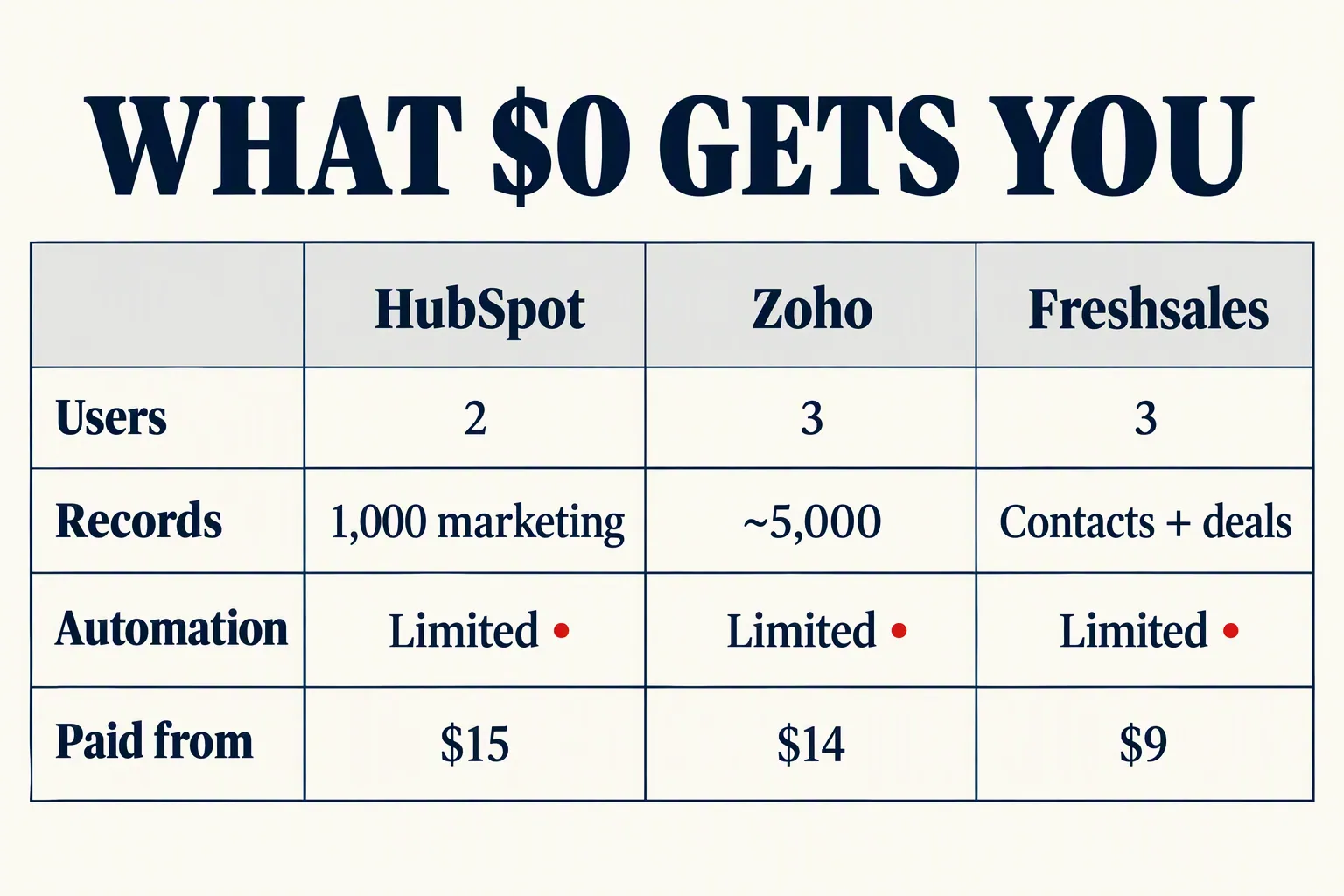
- HubSpot free: contacts and deals, one pipeline, live chat, forms, a meeting scheduler and 2,000 email sends a month. No real automation, and HubSpot branding on your emails and forms.
- Zoho CRM free: leads, contacts and deals, one sales pipeline, tasks and standard reports for up to three users, with very little automation.
- Freshsales free: contacts and deals, a visual pipeline, built-in phone, email and chat, and five custom fields per module for up to three users.
Free plans hold back automation, branding control and reporting
Free plans are generous with storage and stingy with everything that saves you time.
Automation is the big gap. When a lead fills out your form, a working CRM tags them, sends a welcome email and gives someone a follow-up task in seconds. On a free plan you do each step by hand, or it doesn't happen.
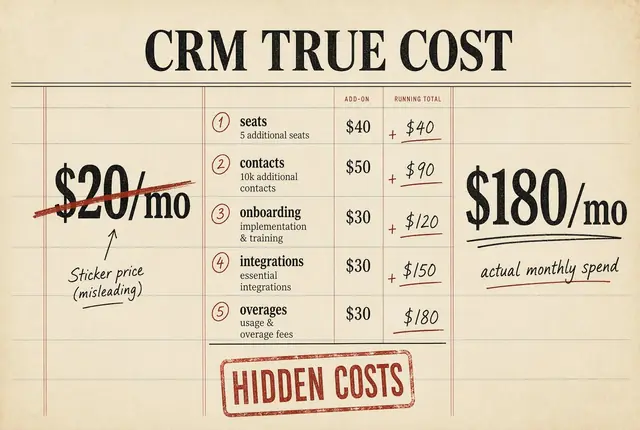
Automation is where most of a CRM's payback comes from. That's why our true cost of a CRM guide treats the subscription as the small part of the bill.
Branding comes next. Free HubSpot puts its logo on your emails, forms and chat, which tells prospects you're small even when you aren't.
Support and reporting are thin too. Free dashboards show how many deals you have, not which source drives revenue or where deals stall. Our CRM automation audit shows how much money hides in those blind spots.
- No automated follow-up sequences or lead routing
- Vendor branding on customer-facing emails, forms and chat
- Standard reports only, no custom dashboards
- Community or email support, not a person on the phone
- Tight storage and small custom-field limits
Staying free too long costs more than the subscription
Once your time has a price, a free CRM stops being free. A two-person team without automation has to send every email, set every task and remember every reminder by hand.
At 100 leads a month, five minutes of manual work per lead is more than eight hours. That's a full workday each month doing what a $20 plan would do on its own.
Missed follow-ups cost even more. Lose three warm leads a month at a $600 average sale and that's $1,800 gone to save $20.
The average CRM returns $8.71 for every $1 spent, according to Which-50's ROI breakdown, and most of that comes from the automation and reporting free plans hold back. Most of your peers are already paying: about 74% of small businesses use a CRM, per SchedulingKit's CRM statistics.
Free plans also make leaving harder than joining, because export options are thin. Clean up your data while it's small.
Upgrade when a specific limit starts costing you money
Upgrade the month a limit starts costing you money, not on a schedule. If you wait, your team learns workarounds that are hard to undo.
Entry prices are close: Freshsales paid plans start around $9 per user a month on the Freshworks pricing page, Zoho Standard is about $14 (both billed annually), and HubSpot Starter is $20 per seat billed monthly, less if you pay annually. So the question is need, not sticker shock.
Upgrade if any of these is true:
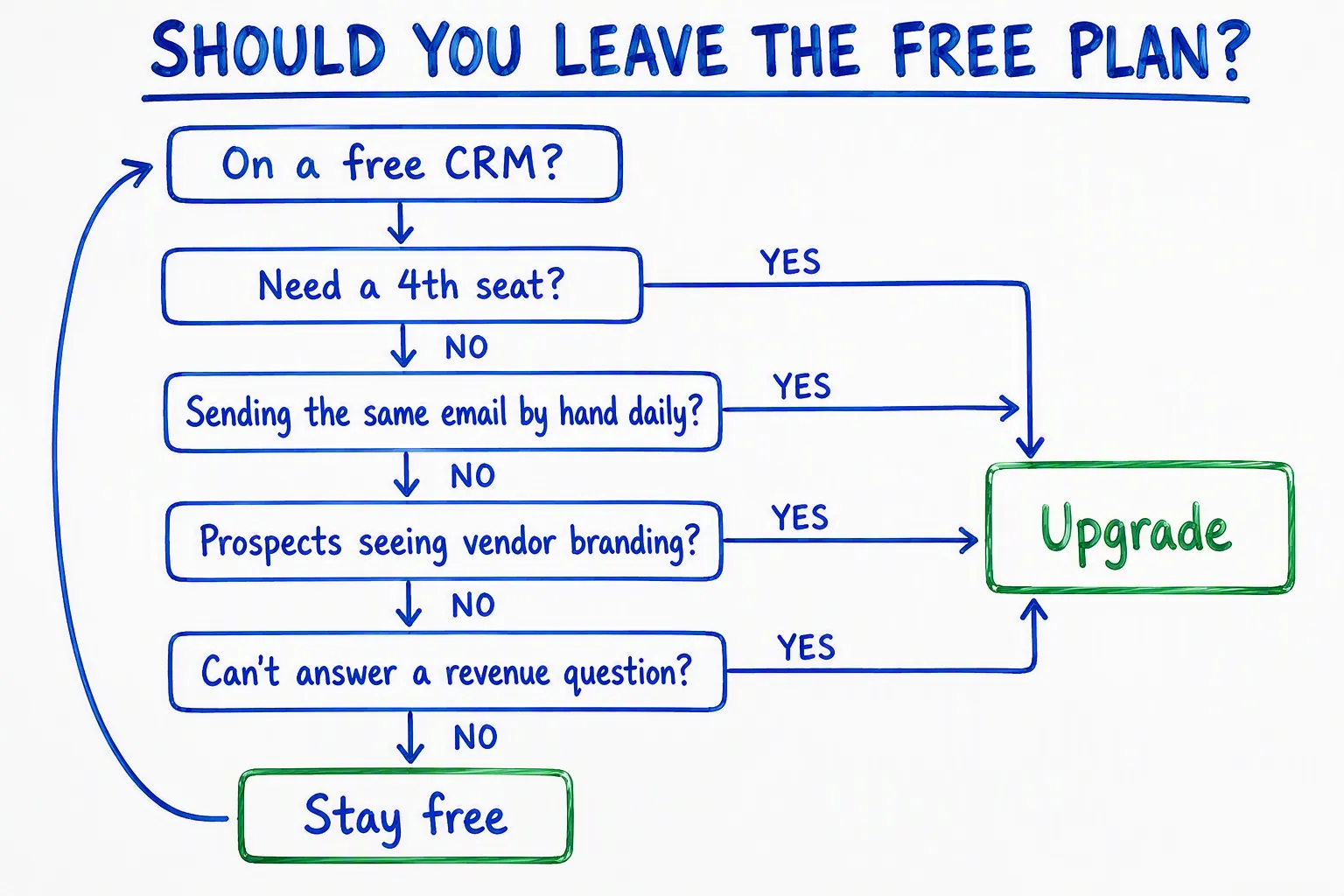
- You need a fourth seat. Zoho and Freshsales stop at three free users.
- You send the same email by hand every day. HubSpot Starter adds automation for $20 a seat a month billed monthly, per HubSpot's pricing page.
- Prospects keep seeing vendor branding on your emails and forms.
- You can't answer a basic revenue question because the free reports won't slice the data.
Start free, but know where the ceiling is
A free CRM is often the right first move. Treat it as a trial with real data: learn which stages matter and which follow-ups convert, then upgrade into a plan that fits.
Most CRMs let you upgrade in place, so your data stays put and the paid features switch on. Before you do, make sure you're only paying for what you'll use. Our guide to choosing a CRM without overbuying helps with that.
Still on a spreadsheet? Read CRM vs spreadsheet first. A free plan is a fine bridge as long as you know where the wall is.
How we write these: we set up and use these tools for real small businesses, check vendor pricing pages and documentation, and link our sources. We earn affiliate commissions from Systeme.io and GoHighLevel; that never decides what goes in a guide.