How to Pick a CRM Without Buying Features You'll Never Touch
The biggest CRM mistake happens before you even sign up. You buy for the business you want to be in two years, not the one you're running today. That's how you end up paying $800/month for a tool you use to send emails and store contacts.
Start with how you make money
The first question isn't "which CRM has the most features." It's "how does money enter your business?" A course creator selling a $297 program, a consultant booking discovery calls, and an agency managing 20 client accounts each need fundamentally different tools.
If you run a simple funnel — email nurture, checkout, delivery — the best CRM is the one that gets the entire path live fastest. If you run on account management, client reporting, and multi-step fulfillment, you need something built for that complexity.
- Solo creators: you need a funnel and a way to deliver. That's it.
- Service businesses: lead routing, follow-up automation, and appointment booking.
- Agencies: account separation, permissions, and repeatable client workflows.
What needs to work in the first 30 days?
Most people compare CRMs by staring at the longest feature grid they can find. Flip it: define the minimum stack that has to work in month one for the software to pay for itself.
That list is usually: lead capture, one nurture sequence, one conversion path, a reporting view, and a handoff process. Everything else can wait. If a platform can't handle month one clearly, it doesn't matter how many advanced modules it ships in year three.

The real cost isn't the subscription
A $27/month tool that does what you need costs less than a $97/month tool that also requires four bolt-ons, two days of training, and a consultant to set up the automations. But a $97/month tool that replaces five separate subscriptions saves you money and headaches.
The best CRM is the one where your team knows exactly where everything lives: landing pages, contacts, automations, and sales. That clarity compounds fast when you're moving fast.
The shortlist is short on purpose
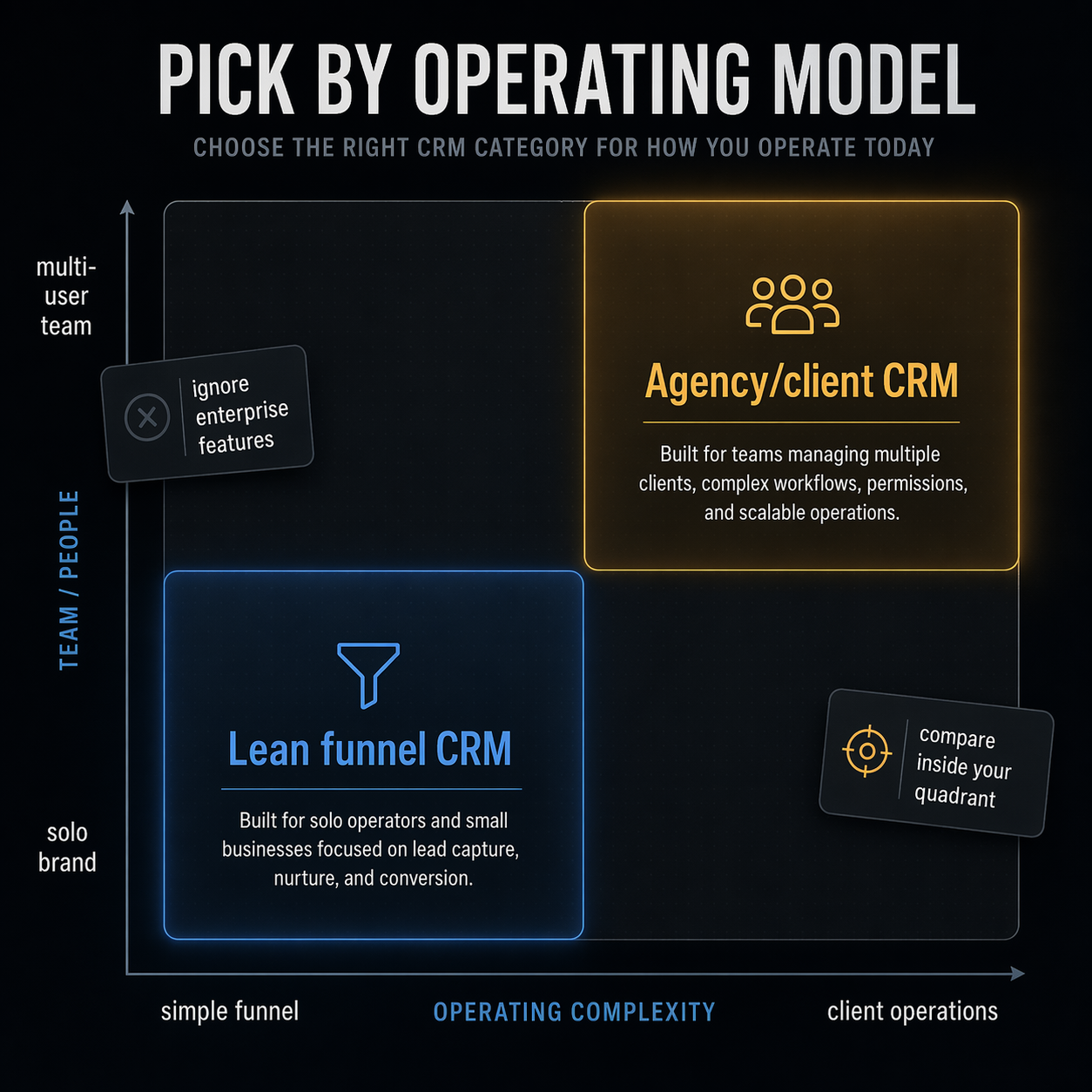
If you're a solo operator, coach, consultant, or course creator selling under one brand — you want something lean that gets out of your way. If you're running client accounts, multi-user permissions, or white-label delivery — you need a system built for that from the ground up.
That's why the decision usually comes down to two options, not twenty. Put your business model on the map first, then compare tools only inside the quadrant you actually occupy. A short list means the decision is based on your workflow, not on which sales demo was flashiest.