CRM referral tracking: turn happy clients into a pipeline
Your best source of new business is already in your CRM. They're the clients who gave you a five-star review, renewed without hesitating, and told you "I mentioned you to a friend" in passing. But you don't have a system to capture that. No pipeline, no automation, no follow-up. According to Shno's 2026 referral research, 83% of happy customers would refer a brand they trust — but only 29% actually do. The gap isn't willingness. It's that nobody asked them at the right time, in the right way. CRM referral tracking closes that gap. It gives every warm introduction a place to live, a next step, and a follow-up sequence that doesn't depend on you remembering to send a text.
Why referrals close better but still get ignored
Referrals aren't just "nice leads." They're a fundamentally different category. The person walking in already trusts you because someone they trust vouched for you. That changes every part of the sales conversation.
The numbers back this up. Referred leads convert 3 to 5 times more often than leads from paid ads or cold outreach, according to Shno's referral program data. They also churn 18% less and carry at least 16% higher lifetime value.
So why do most small businesses ignore this channel? Because it feels informal. A client mentions your name to a colleague, and you hear about it three weeks later in a casual email. There's no trigger, no pipeline stage, no task. It sits in a thread somewhere, and half the time you forget to follow up.
The irony is painful. You're spending $500 a month on ads to generate cold leads that close at 2%, while your happiest clients would happily send you warm intros — for free — if you had a system that prompted them at the right moment.
CRM referral tracking isn't a loyalty program with points and tiers. It's simpler than that. It's a pipeline, a trigger, and a few automations that make sure you always ask and always follow up.
Build a referral pipeline in five fields
You don't need referral software. You need five custom fields and one dedicated pipeline in the CRM you already pay for. Here's the setup.
Create a new pipeline called "Referrals" with four stages: Requested, Intro Made, In Conversation, and Closed. Every referral moves left to right just like your sales deals. This gives you visibility you've never had — how many referrals are active, where they stall, and which clients generate the most introductions.
Next, add these five fields to your contact records:
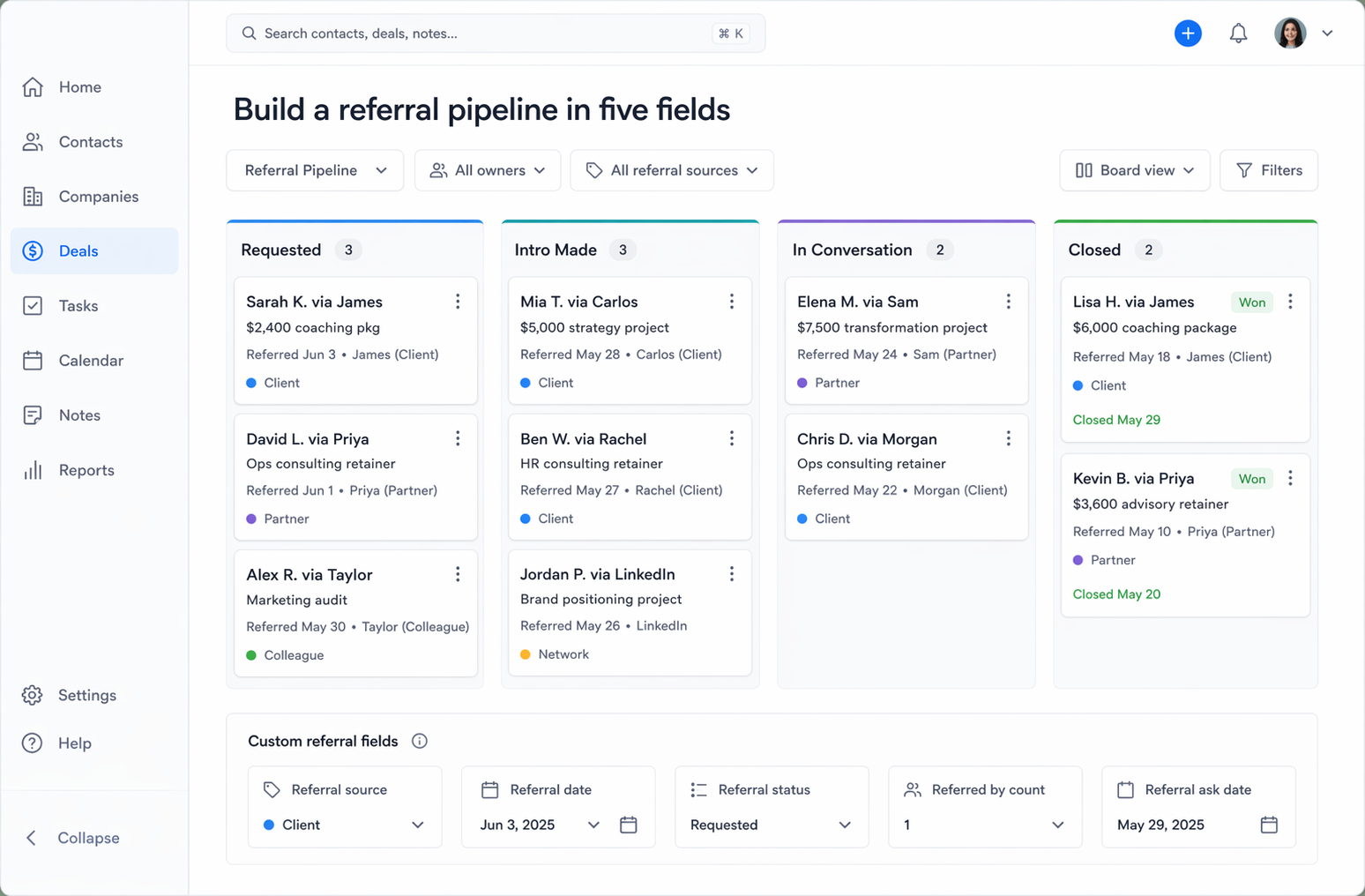
- Referral source — the name of the client who made the introduction. This is your single most important attribution field.
- Referral date — when the introduction happened. You'll use this to measure speed-to-close for referred vs. non-referred deals.
- Referral status — Pending, Contacted, Won, or Lost. Keep it simple.
- Referred by count — a running tally on the referring client's record. This tells you who your top advocates are.
- Referral ask date — the last time you prompted this client for a referral. Prevents you from asking too often or not often enough.
Automate the ask so it happens every time
The biggest failure in referral programs isn't the reward structure. It's that nobody asks. Impact.com's research found that 60% of customers who never participated in a referral program simply hadn't received a referral link or request. They weren't opposed — they were never prompted.
Your CRM can fix this with one automation: trigger a referral request after a positive milestone. That milestone depends on your business. For coaches, trigger 7 days after a client hits their first goal. For agencies, trigger after you deliver the first monthly report with positive results. For service businesses, trigger 3 days after a project closes with a satisfaction rating above 4.
The message itself should be short and specific. Don't say "know anyone who could use our services?" Say "you mentioned your friend Sarah runs a coaching practice — would it be helpful if I sent her the same audit we did for you?" Give them a name, a reason, and an easy yes.
Keep the ask low-friction. A reply to an email or a single link to share works better than a formal referral form. The fewer steps, the higher the conversion. According to MarketingScoop's small business data, referral acquisition costs 15 to 25 times less than paid channels — but only when the ask actually gets sent.
Set a cadence rule in your automation: don't ask the same client more than once per quarter. Update the "Referral ask date" field each time the automation fires so you can track frequency without annoying your best clients.
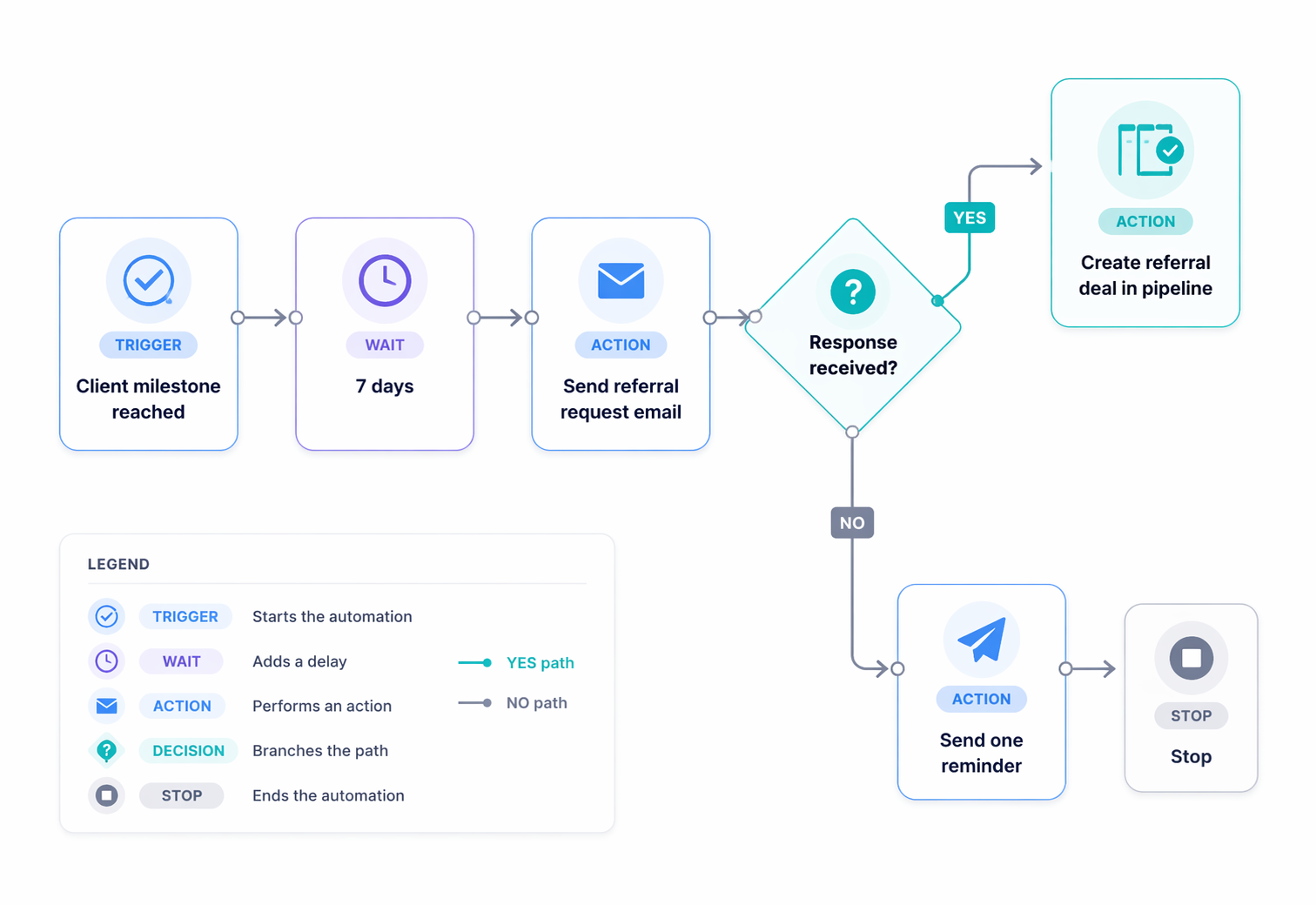
- Trigger timing by business type: coaches (7 days post-milestone), agencies (after first positive report), service businesses (3 days post-close with high satisfaction), SaaS (30 days post-signup if still active).
- Message format: name a specific person or context, give a reason, make it a one-click yes.
- Cadence: once per quarter maximum. Update the "Referral ask date" field on each send.
- Follow-up: if no response in 7 days, send one gentle reminder — then stop. Two touches is the limit.
How to set this up in GoHighLevel or HubSpot
The framework works in any CRM, but here's where to click in the two platforms we see most.
In GoHighLevel, you get the full automation suite on the Starter plan at $97/month. Create your referral pipeline under Opportunities, add custom fields under Settings > Custom Fields, and build the ask-automation in Workflows with a trigger like "Pipeline Stage Changed" or "Tag Applied." GoHighLevel's native affiliate tracking also lets you generate unique referral links per client if you want a self-service option.
In HubSpot, referral workflows require the Marketing Hub Professional tier at $890/month plus a $3,000 onboarding fee. You'll build the pipeline under Deals, create custom properties for your referral fields, and set up the automation in Workflows with an enrollment trigger based on deal stage or NPS score. It works well, but the price gap is massive for a small team.
For most businesses under 20 employees, GoHighLevel gives you the same referral automation at roughly one-ninth the cost. If you're already on HubSpot's Professional plan for other reasons, you won't need a separate tool. But don't upgrade to Pro just for referral tracking — that math doesn't work.
If you're still deciding between platforms, our guide to choosing a CRM without overbuying breaks down the feature-to-price tradeoffs in more detail.
Measure what matters: three referral metrics to watch
Once your pipeline is running, you need three numbers on a monthly dashboard. Not twelve. Three.
First: referral velocity. How many days from "intro made" to "closed"? Compare this against your non-referral deals. In most businesses, referred deals close 40-60% faster because trust is pre-built. If your referral velocity isn't meaningfully faster, something in your follow-up process is adding unnecessary friction.
Second: ask-to-intro rate. Of all the referral requests your automation sends, what percentage result in an actual introduction? If it's below 10%, your message needs rewriting or your timing is off. If it's above 25%, you've found something that works — don't touch it.
Third: top referrer concentration. Are 80% of your referrals coming from two clients? That's a risk. If those clients leave or get busy, your referral pipeline dries up overnight. Use this metric to identify who else might refer if prompted, and start expanding your base.
Skip vanity numbers like "total referrals received." A hundred referrals that never convert are worth less than five that close. The pipeline stages give you conversion data at each step — use them the same way you'd diagnose a leaky sales pipeline.