In this guide (6 sections)
- Most new leads need a lead nurture sequence, not a sales call
- A good lead nurture sequence is six emails over three weeks
- Write each nurture email around one question your lead is asking
- Set exit rules so warm leads reach you fast
- How to build a lead nurture sequence in Systeme.io or GoHighLevel
- Judge your nurture sequence on booked calls, not opens
Most people who download your freebie or join your list aren't ready to buy that week. If all they get is a welcome email and your next newsletter, they forget you. A lead nurture sequence fixes that: a short run of automated emails that answers their doubts and asks for the call when they're warm.
Most new leads need a lead nurture sequence, not a sales call
A new lead is curious, not committed. Pushing them to a call on day one scares most of them off, and ignoring them wastes the money you spent to get them.
A nurture sequence sits in between. It runs on its own, it's timed to when each person signed up, and it does the warming up you don't have time for.
The numbers back this up. In Omnisend's 2026 email benchmarks, welcome automations averaged a 35.5% open rate and a 3.94% click rate. Regular campaign emails averaged 30.2% opens and 0.88% clicks. Automated emails overall made about 22 times more revenue per email.
That's ecommerce data, so don't treat it as your forecast. But the pattern holds for coaches and consultants too: an email that arrives right after someone raises their hand gets read.
Say you get 100 new leads a month and three book a call straight away. The other 97 are where a nurture sequence earns its keep.
Without one, those 97 hear from you whenever you next remember to send a newsletter. By then, many have forgotten what they signed up for. Some will have bought from someone who kept in touch.
A nurture sequence isn't the same as a win-back campaign. Win-back is for people who went quiet months ago. Nurture is for people who just arrived and are still paying attention.
A good lead nurture sequence is six emails over three weeks
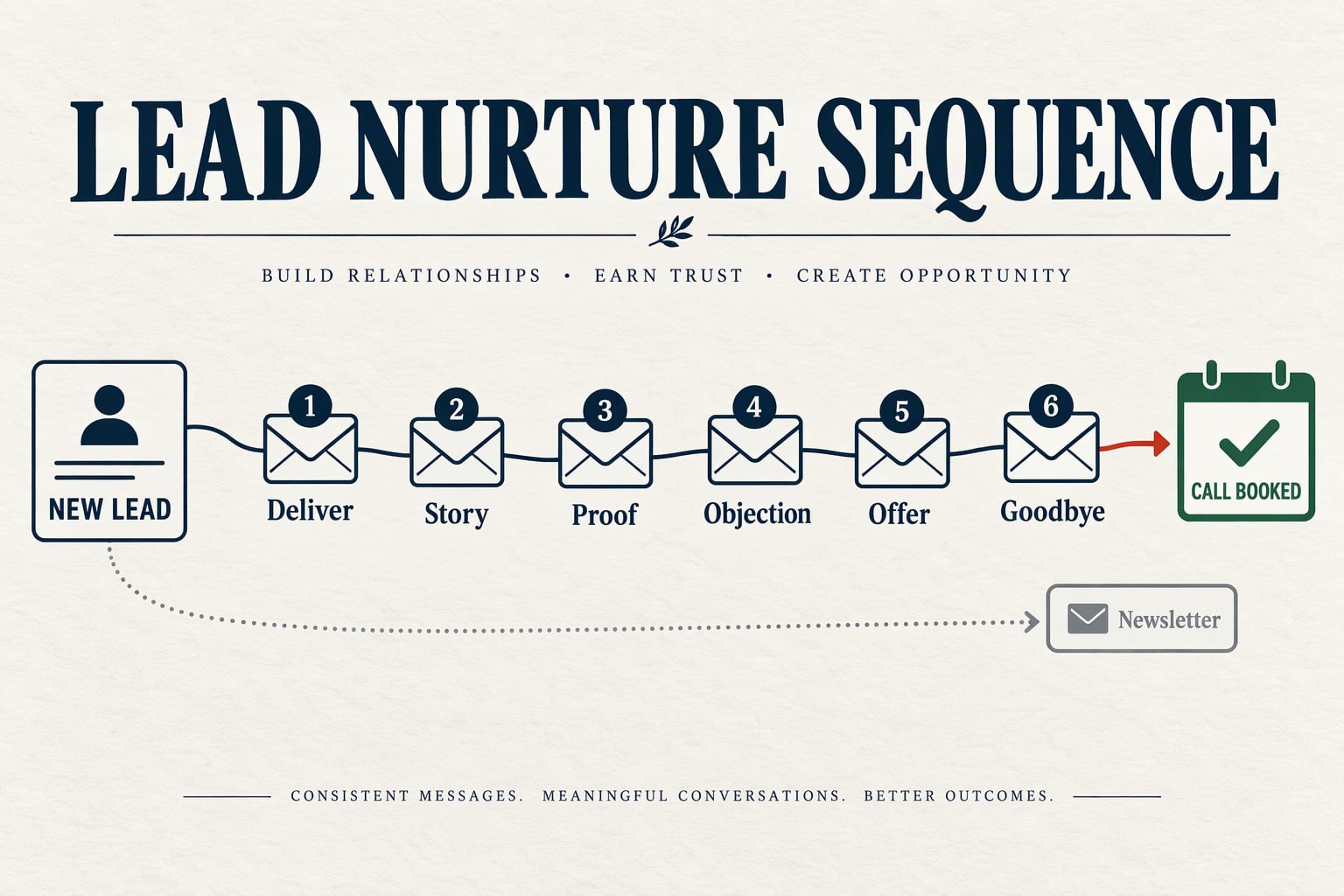
Six emails is enough to build trust without becoming noise. Spread them over about three weeks, front-loaded while the sign-up is fresh.
Each email gets one job. When an email tries to teach, prove and sell at once, it does none of them well.
Don't send daily. Daily emails feel like a launch, and launches burn out a cold list fast. Every two to five days keeps you familiar without crowding their inbox.
Selling a low-priced course or template instead of a service? Keep the same six jobs but swap the call for a checkout link, and move the offer up to day 7. Cheaper products need less convincing, so a shorter run usually works.
Here's the outline we'd start with for a service business. Stretch the gaps if your sales cycle is long, or shrink them if people usually decide within a week.
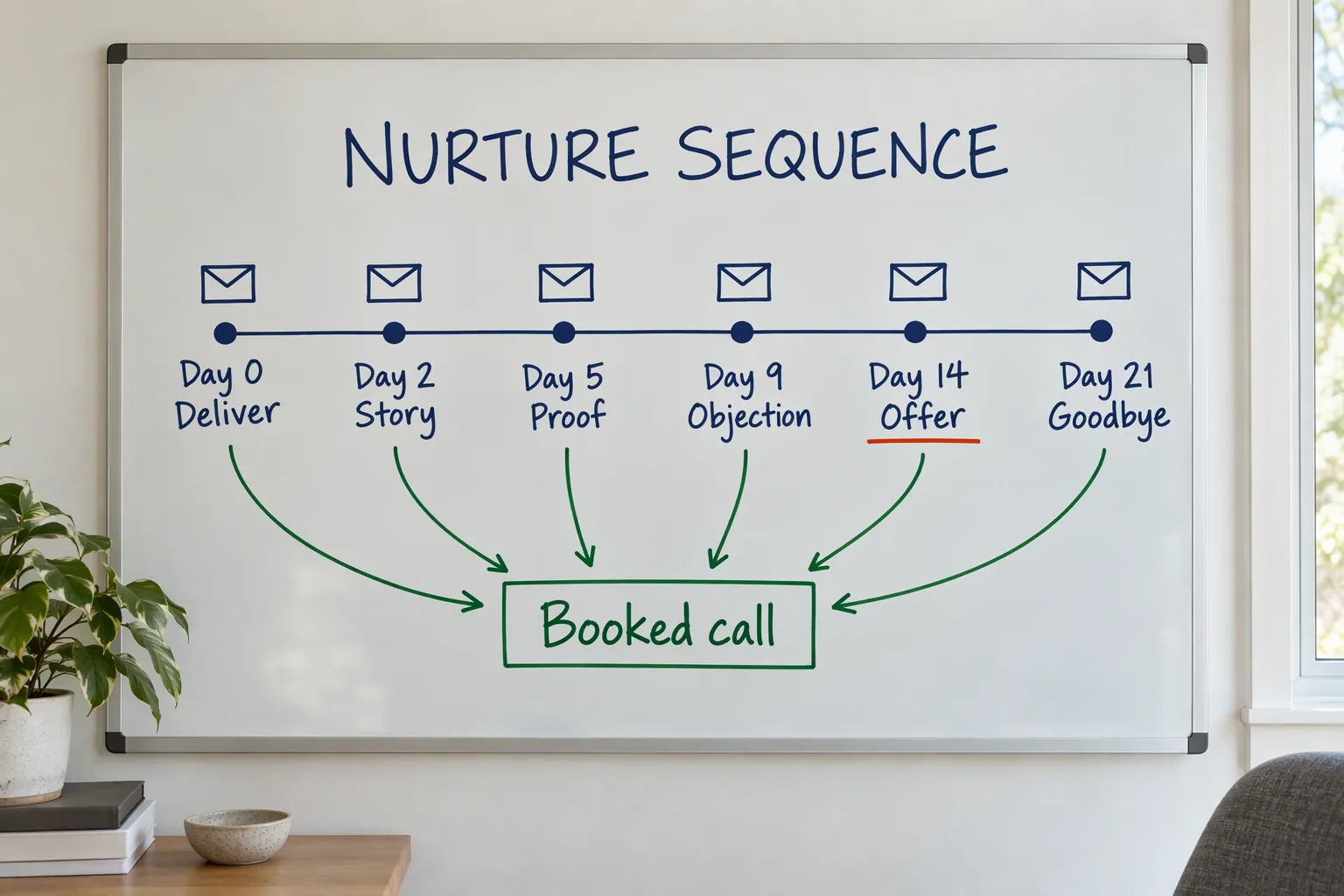
- Day 0, deliver: send the freebie they asked for and tell them what to expect next. Keep it short.
- Day 2, your story: why you do this work and who you help. One problem you've solved, told plainly.
- Day 5, proof: a real result, a before-and-after, or a worked example. No invented testimonials.
- Day 9, the objection: answer the biggest reason people hesitate, like price, time or "will this work for me?"
- Day 14, the offer: say what you sell, who it's for, what it costs, and how to book or buy.
- Day 21, goodbye: tell them this is the last email in the series and ask one easy question.
Write each nurture email around one question your lead is asking
Every lead is quietly asking something: "Is this for me?", "Can I trust you?", "What will it cost me?" Each nurture email should answer one of those questions.
Write down the five questions you hear most on sales calls. Those are your emails. You don't need to invent topics when your prospects already gave them to you.
Keep each email under 200 words with one link. Write it like a note to one person, from your own name, not "The Team." Plain text usually feels more personal than a designed template.
End every email with an easy reply prompt, such as "Hit reply and tell me where you're stuck." Replies tell inbox providers that people want your mail, and each one is a warm conversation.
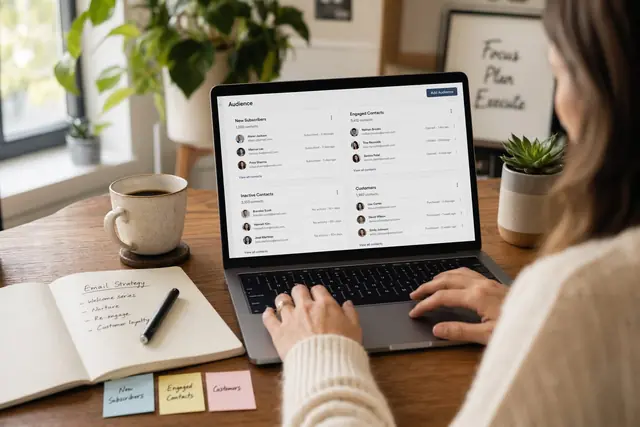
If your list mixes very different people, split them before they enter the sequence. Our email segmentation guide shows how to tag leads by what they signed up for, so a course buyer and a consulting lead don't get the same story.
- A sample day 9 email for a hypothetical business coach: "Most people who download my pricing guide tell me the same thing: they're worried a coach costs more than it returns. Fair. Here's how one client covered my fee in the first month by raising one price. If cost is what's holding you back, hit reply and tell me your current rate."
- Subject lines that work: "The checklist you asked for", "Why I stopped selling packages", "Is $2,000 too much for this?"
- Subject lines to avoid: "Newsletter #4", "Don't miss out!!", or anything that hides what's inside.
Set exit rules so warm leads reach you fast
Exit rules are what make a nurture sequence smart. Without them, someone who booked a call yesterday still gets your "Is this for me?" email tomorrow.
Set three exits before you turn anything on. Then add a hand-off, so the people showing real interest reach you while they're still warm.
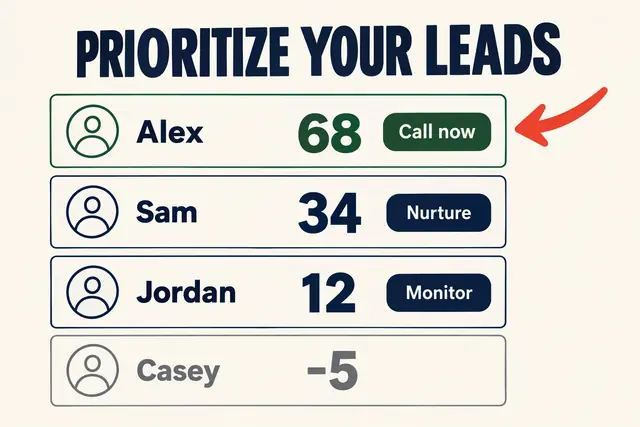
For the hand-off, a simple score works. Add points for clicking the offer link or visiting your pricing page, and create a task for you once someone crosses your line. Our CRM lead scoring guide has starter rules and thresholds.
Don't let a lead sit in two sequences at once. If someone downloads a second freebie mid-sequence, finish the first one or switch them over, but never send both. Most CRMs have a setting that blocks a contact from entering a workflow they're already in.
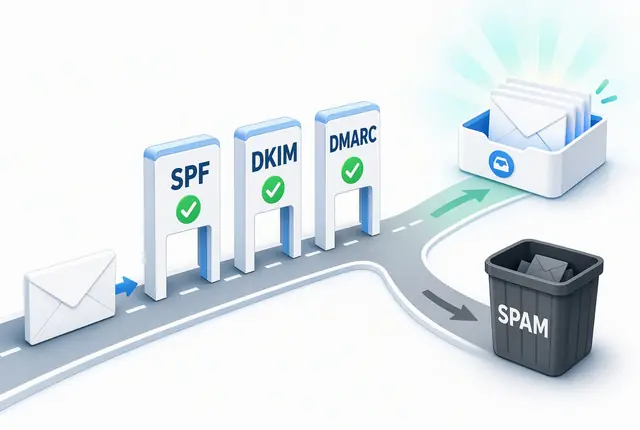
Watch complaints too. Google's email sender guidelines say to keep your spam rate below 0.3% and to offer one-click unsubscribe on marketing mail. A sequence that annoys people can hurt every other email you send.
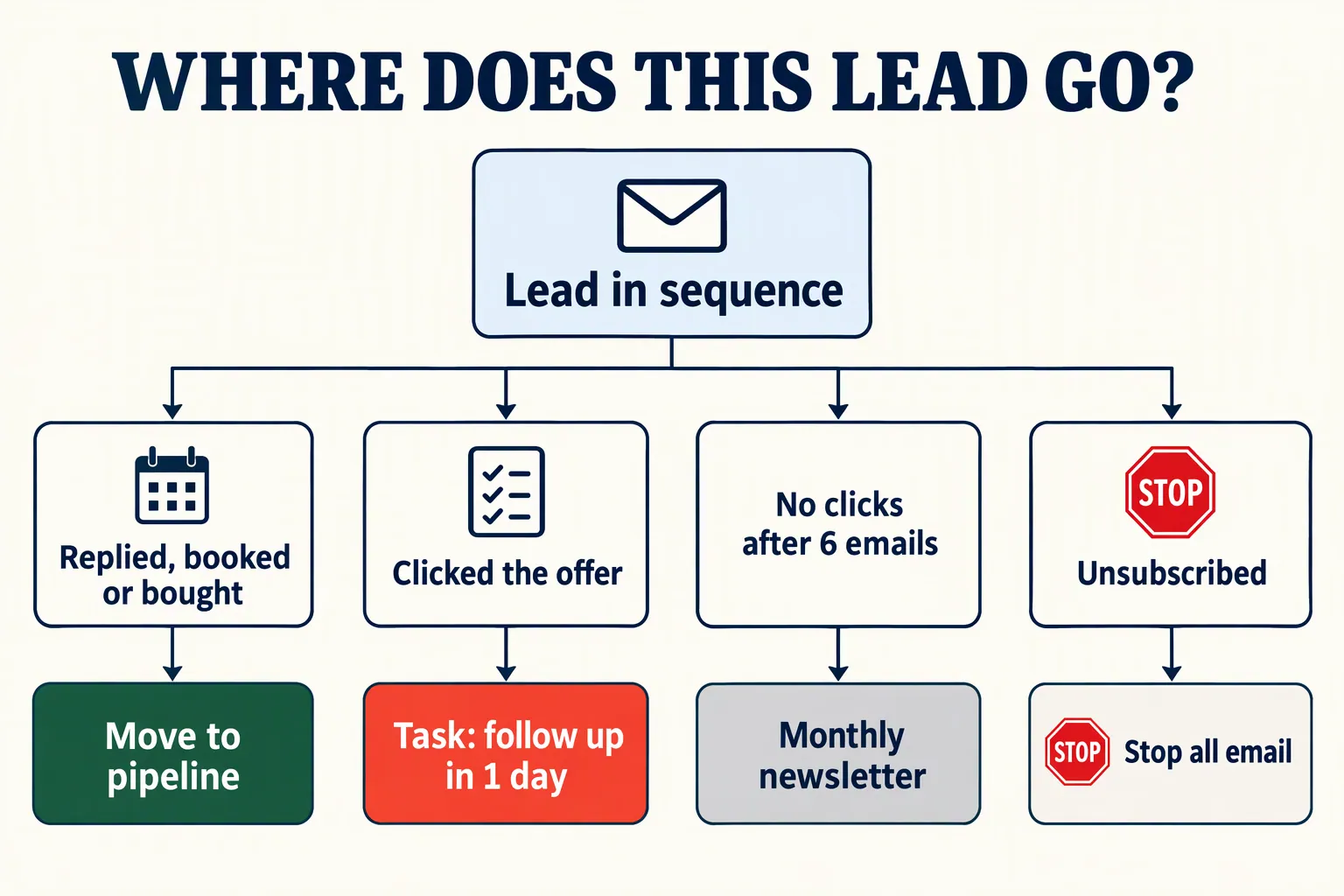
- Replied, booked or bought: remove them from the sequence and move them into your pipeline.
- Clicked the offer link or hit your score threshold: create a follow-up task for you within one business day.
- Finished all six emails with no clicks: move them to your regular newsletter, not another sales sequence.
- Unsubscribed or marked as spam: stop all marketing email at once.
How to build a lead nurture sequence in Systeme.io or GoHighLevel
The setup is the same in any CRM: a trigger, six emails with delays, and exit rules. Only the menus change. Prices below were checked November 2026.
In Systeme.io, build the six emails as a campaign, then add an automation rule that subscribes anyone who submits your opt-in form. The free plan allows one campaign and one automation rule, which is enough for one sequence. Paid plans start at $17/mo billed monthly and raise those limits.
In GoHighLevel, build it as a workflow triggered by your form submission, with wait steps between emails. Add goal events for "appointment booked" and "order paid" so people leave as soon as they convert. The Starter plan is $97/mo and covers email, texting and the pipeline in one place.
Not sure which platform fits how you sell? Our Systeme.io vs GoHighLevel comparison breaks it down by business model.
If you're on HubSpot or ActiveCampaign, the same pattern applies. Check that your plan includes automated sequences before you write anything, because free tiers often leave them out.
Before you go live, sign up with your own email and a colleague's. Read every message on your phone, click every link, then book a test call to confirm the sequence stops.
- Trigger: opt-in form submitted, or a tag like "lead-pricing-guide" added.
- Delays: 0, 2, 5, 9, 14 and 21 days after sign-up, sent in the lead's morning if your CRM supports time zones.
- Goals: booked call, paid order or reply removes them from the sequence.
- Sender: your own name and a reply-to address someone actually reads.
Judge your nurture sequence on booked calls, not opens
Give the sequence 30 days, then check three numbers. Open rates are unreliable since Apple Mail started preloading images, so treat them as a rough signal at best.
Expect some unsubscribes and don't panic. Omnisend found automated emails averaged a 0.59% unsubscribe rate, against 0.20% for campaigns. New leads are still deciding whether they want to hear from you.
Compare the lead nurture sequence against what happened before you built it. If 3 in 100 leads used to book a call and now 5 do, that's two extra sales conversations a month from emails you wrote once.
Fix the weakest email first. If one email gets most of the unsubscribes, rewrite it. If clicks drop off sharply after the story email, your proof email probably needs a stronger example.
Ask the people who booked what made them do it. Their answers tell you which email to keep and which to cut, which no report will.
Once the sequence works, keep it running and stop tinkering for a quarter. Leads who never engage can join your next win-back campaign a few months later.
- Booked calls or sales from the sequence: the only number that pays your bills.
- Replies: a sign people trust you enough to write back.
- Unsubscribes per email: anything well above 1% on a single email means that email needs work.
How we write these: we set up and use these tools for real small businesses, check vendor pricing pages and documentation, and link our sources. We earn affiliate commissions from Systeme.io and GoHighLevel; that never decides what goes in a guide.