Add SMS to your CRM follow-up (without the $1,500 fines)
You built a follow-up sequence that fires emails for two weeks after someone fills out your form. Open rate? Maybe 25% on a good day. Response rate? You'd rather not check. Meanwhile, according to Sakari's 2026 SMS research, SMS gets a 45% response rate and 90% of texts get read within three minutes. CRM SMS follow-up isn't a nice-to-have anymore. It's the gap between reaching your lead before a competitor does and wondering why nobody replies. But there's a catch: text a lead without proper consent and you're staring at $500 to $1,500 per message in TCPA fines. This guide shows you how to add SMS to your CRM the right way — compliant, effective, and worth the per-message cost.
SMS response rates make email look broken
The numbers aren't subtle. According to Omnisend's 2026 SMS data, text messages hit a 98% open rate. Email sits around 20-30%. Click-through rates for SMS run 21-35%, while email averages 2.5-4%. Response rates? 45% for SMS, 6% for email.
This isn't because people love getting texts from businesses. It's because a text message lands in the same inbox as messages from their spouse, their kids, and their best friend. It's physically impossible to ignore. Your email lands between a Costco promo and a password reset notification.
For small businesses where speed matters — consultants booking calls, coaches confirming sessions, agencies following up on proposals — that gap is revenue. SPOTIO's research shows 35-50% of sales go to whoever responds first. A text arrives in three seconds. An email might get opened tomorrow. Maybe.
The ROI backs this up. RevenueMemo's 2026 analysis found SMS marketing returns between $21 and $41 for every dollar spent. Automated flows — appointment reminders, abandoned cart nudges, follow-ups — can generate 30x more revenue per recipient than one-off blasts.
You don't need to replace email. You need to add SMS at the moments where speed and visibility matter most. That's usually the first 24 hours after someone raises their hand.
TCPA compliance isn't optional (and the fines are per text)
Here's where most small businesses mess up. They get excited about SMS response rates, import their contact list, and blast 500 people a "hey, still interested?" text. Then they get a cease-and-desist letter — or worse, a class action.
The Telephone Consumer Protection Act is the federal law governing business texts. It's not new, but the FCC tightened the rules in April 2025. Here's what matters for your CRM SMS follow-up:
You need express written consent before sending any marketing text. That means a checkbox (not pre-checked), a web form signature, or a keyword opt-in like "text JOIN to 55555." A previous purchase doesn't count. An existing email relationship doesn't count. They have to explicitly agree to receive texts.
Every message must include your business name and a way to opt out. "Reply STOP to unsubscribe" is the standard, but under the 2025 FCC update, consumers can now opt out by any reasonable means — including replying "leave me alone" or "unsubscribe." Your system needs to catch those.
Fines are $500 per message for standard violations and $1,500 per message for willful violations. Send 200 non-compliant texts and you could owe $100,000 to $300,000. These aren't theoretical — TCPA class actions are one of the most common consumer lawsuits in the U.S.
You also need to text only between 8 a.m. and 9 p.m. in the recipient's local time zone. And you must keep consent records for at least five years. If someone disputes that they opted in, you need proof.
None of this is hard to set up in a modern CRM. But you have to set it up before you send your first text, not after a complaint.
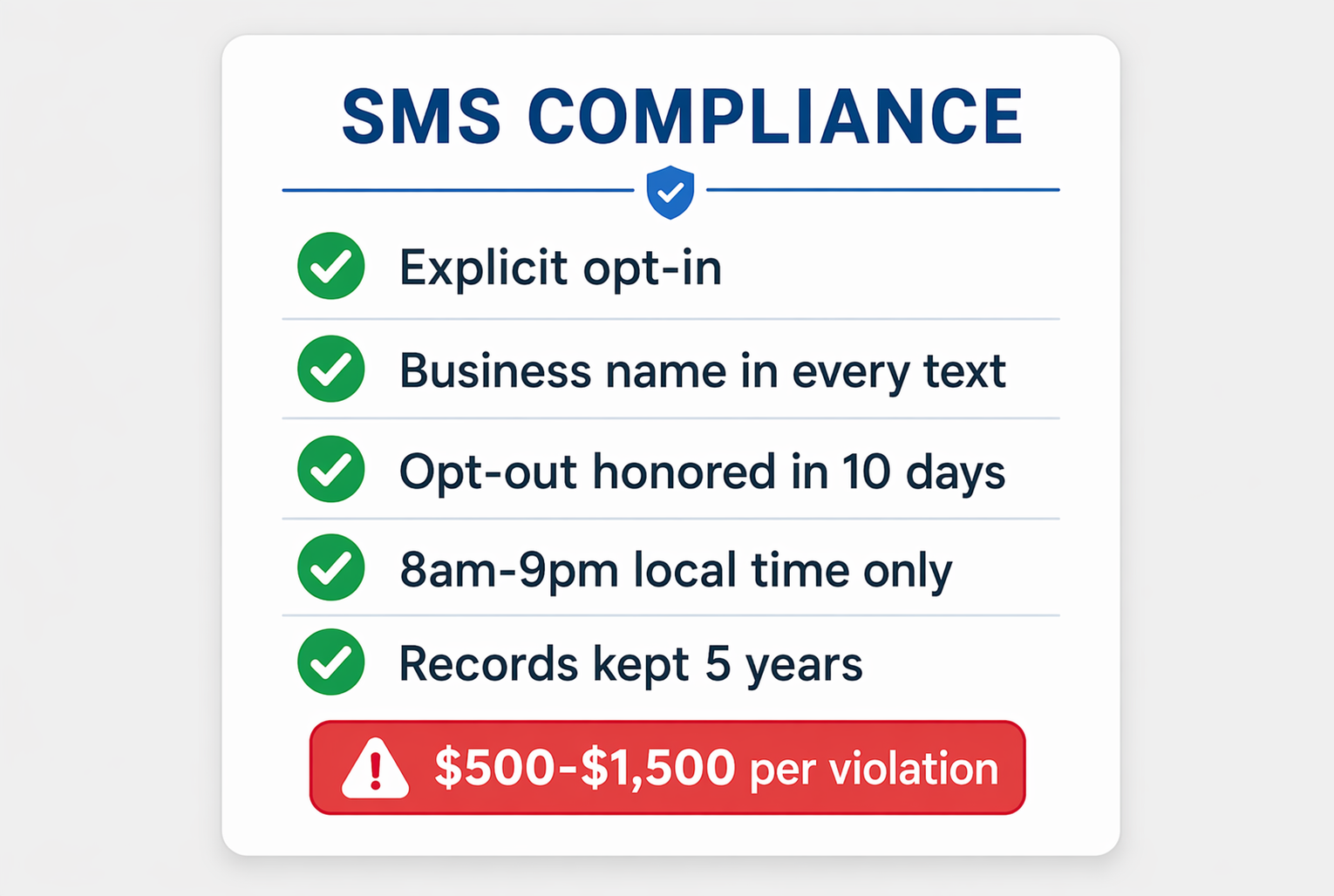
- Get explicit opt-in: unchecked checkbox, keyword text-in, or signed consent form.
- Include your business name and opt-out instructions in every message.
- Honor opt-outs within 10 days — even informal ones like "stop texting me."
- Text only between 8 a.m. and 9 p.m. in the recipient's time zone.
- Keep consent records (timestamps, method, source) for at least five years.
Five CRM SMS workflows that actually move deals
Not every CRM text should be a sales pitch. The best SMS workflows are short, timely, and useful. Here are the five that consistently produce results for small teams:
- Speed-to-lead text: fires 60 seconds after a form submission. "Hey [name], got your request. I'm [your name] — want me to call you now or schedule a time this week?" This alone can double your contact rate. If you haven't optimized your speed-to-lead response time, start here.
- Appointment reminder: 24 hours and 1 hour before a booked call. "Quick reminder — we're on for tomorrow at 2pm. Reply YES to confirm or let me know if we need to reschedule." Reduces no-shows by 30-40% in most service businesses.
- Proposal follow-up: 48 hours after sending a proposal with no response. "Sent your proposal Tuesday — any questions I can answer? Happy to jump on a quick call." This catches people who opened your email but got distracted.
- Re-engagement nudge: contacts who went quiet after showing high intent (visited pricing, opened 3+ emails, started checkout). One text, 5-7 days after they went cold. Keep it casual and give them an easy out.
- Post-purchase check-in: 7 days after purchase. "Hey [name] — how's everything going with [product/service]? Reply here if you need anything." This is a retention play. One text prevents the "I forgot I bought this" churn that kills recurring revenue.
What SMS costs in GoHighLevel, HubSpot, and ActiveCampaign
SMS isn't free like email. Every text costs money — and the price varies wildly depending on which CRM you're in.
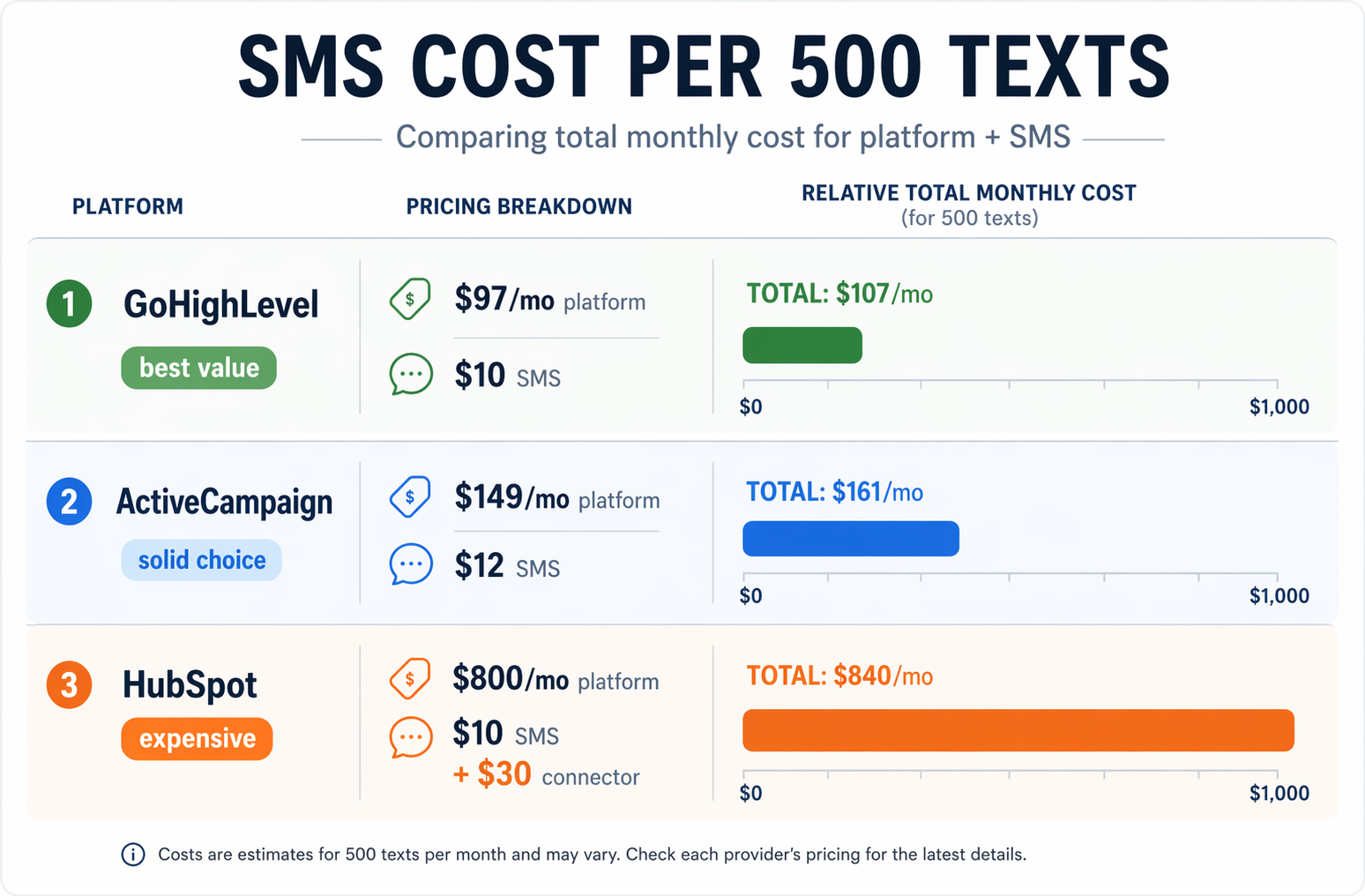
GoHighLevel bakes SMS into every plan starting at $97/month. You pay per message through their LC Phone system: about $0.016 per SMS segment plus a $0.0045 carrier fee, totaling roughly $0.02 per text. If you connect your own Twilio account instead, costs drop to about $0.008 per message. For a business sending 500 texts per month, that's $10 on Twilio or $10-12 on LC Phone. The automation builder treats SMS as a first-class channel — same workflow editor as email, voice, and chat.
HubSpot doesn't offer native SMS. You need a third-party integration like Sakari or Twilio through the marketplace. That adds $25-50/month for the connector plus per-message Twilio costs. And you need the Professional tier at $800/month to get the workflow automation that makes SMS sequences useful. For the same 500 texts, you're paying $800+ for the platform before you send a single message.
ActiveCampaign includes native SMS on Plus plans and above, starting around $149/month for 2,500 contacts. Messaging volume carries additional per-message fees similar to GoHighLevel's structure. The workflow builder integrates SMS triggers and conditions well, but pricing scales with your contact list.
The takeaway: if SMS is a priority channel for you, GoHighLevel is the obvious value pick. You get native SMS at every tier for one-fifth the cost of HubSpot's entry point. ActiveCampaign lands in the middle — solid SMS, higher per-contact costs. If you're comparing the broader platform differences, our Systeme.io vs GoHighLevel breakdown covers the full stack.
Set up your first CRM SMS sequence this week
You don't need to overhaul your whole follow-up stack. Start with one workflow — the speed-to-lead text — and expand from there.
Step one: add an SMS opt-in checkbox to your lead capture form. Something like "I'd like to receive text updates about my request. Message and data rates apply. Reply STOP to opt out." Your CRM should tag contacts who check this box.
Step two: create a workflow triggered by form submission that checks for the SMS consent tag. If present, send the speed-to-lead text within 60 seconds. Keep it under 160 characters so it doesn't split into multiple segments (which costs double).
Step three: add a 24-hour delay, then a conditional check. Did they reply? Did they book? If yes, exit the SMS sequence. If no, send one follow-up text — and only one. Nobody wants three texts from a business they just met.
Step four: monitor your opt-out rate for the first two weeks. Industry average is 1-2% per campaign. If you're above 5%, your timing or messaging needs work. If you're below 1%, you're probably being too cautious — test adding a second workflow.
That's it. One form update, one workflow, two texts. You can build this in under an hour in GoHighLevel or ActiveCampaign. If you need help designing the full automation workflow, audit what you already have first — then layer SMS on top.
Don't text like a robot
The fastest way to burn your SMS channel is to write texts that sound like marketing emails stuffed into 160 characters. Nobody wants "Dear valued customer, we wanted to let you know about an exciting opportunity..." in their text inbox.
Good CRM texts sound like a person wrote them. Short. Casual. One clear ask or one useful piece of info. Use their first name. Sign with yours. Skip the exclamation marks and the emoji strings.
Here's a simple test: would you send this text to a friend? If it sounds weird out loud, rewrite it. "Hey Sarah, just following up on your consultation request. Want me to call you this afternoon?" works. "ATTENTION: Your consultation inquiry has been received. A representative will be in touch." doesn't.
SMS is the most personal channel you have access to. Treat it that way, and your response rates stay high. Treat it like a broadcast channel, and people will opt out fast — taking your best leads with them.